
Vannevar Bush was a scientist of many accomplishments. He designed some analog precursors to modern computers, and during World War II, ran the organization that oversaw all scientific research with military applications, including the origins of the Manhattan Project. Curiously, he may ultimately be remembered for a rather minor article he wrote speculating on a future machine for data retrieval that bears a remarkable resemblance to the hypertext employed by the World Wide Web.
Vannevar — which rhymes with "receiver" — Bush was born March 11, 1894, in Chelsea, Massachusetts, the son of a Universalist minister. He showed earlier promise in math and attended Tufts University in Medford, Massachusetts, on a half-scholarship, working as a math tutor and aide to make up the difference. He received his bachelor's degree in engineering in 1913 and had advanced so far that he was granted a master's degree at the same time. In 1916, he received a PhD in engineering jointly from Massachusetts Institute of Technology and Harvard College. He then returned to Tufts as an assistant professor.
Soon after United States’ entry into World War I, Bush told the National Research Council that he had an idea for the detection of submarines using magnetic fields. The NRC agreed to let him develop the idea. Bush developed a system that worked in testing, but the Navy was unable to deploy it successfully in the field.
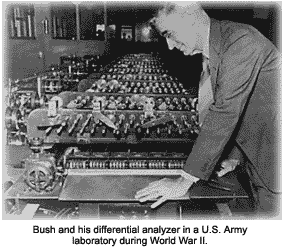 After the war ended, Bush left Tufts and joined the electrical engineering faculty of MIT where he constructed the Differential Analyzer, a mechanized analog computer that solved differential equations with as many as 18 independent variables. And from that, the digital circuit design theory was developed by one of Bush's graduate students, Claude Shannon. Along with Lawrence K. Marshall, a former college roommate, Bush co-founded defense contractor Raytheon Corporation in 1922. His abilities as an administrator were also recognized. MIT made him a vice-president and dean of engineering in 1932 and he was appointed president of the Carnegie Institution of Washington and chairman of the National Advisory Committee for Aeronautics in 1939.
In 1940, Bush proposed to President Franklin D. Roosevelt that an organization be created to bring together the principal participants in research of military value from business, academia, and government. Roosevelt agreed and the new committee, named the National Defense Research Committee was created with Bush as its chairman. The NDRC developed programs of research and development regarding aircraft detection, gun control, proximity fuses, anti-submarine devices, explosives and gases, and uranium for the Army and Navy. The committee was absorbed into the Office of Scientific Research and Development in 1941 and Bush became the new agency's director.
Initially skeptical of the prospects for an atom bomb, Bush became convinced that the bomb was a possibility and that the Germans might be working on one. He used his influence with Roosevelt to get the American bomb development program underway. By 1942, he felt that in order to maintain secrecy, the project should be under military control. Subsequently, responsibility for the atom bomb program was given to the Army, where it was renamed the Manhattan Project after the Manhattan Engineer District of the U.S. Army Corps of Engineers in New York City where much of the early research for the project was done.
As the war drew to a close in 1945, Bush produced a treatise on the future of scientific research in the United States. Entitled "Science, the Endless Frontier," the work outlined ideas for perpetual government funding of research in science and engineering. His recommendations led to the formation of the National Science Foundation in 1950.
After the war ended, Bush left Tufts and joined the electrical engineering faculty of MIT where he constructed the Differential Analyzer, a mechanized analog computer that solved differential equations with as many as 18 independent variables. And from that, the digital circuit design theory was developed by one of Bush's graduate students, Claude Shannon. Along with Lawrence K. Marshall, a former college roommate, Bush co-founded defense contractor Raytheon Corporation in 1922. His abilities as an administrator were also recognized. MIT made him a vice-president and dean of engineering in 1932 and he was appointed president of the Carnegie Institution of Washington and chairman of the National Advisory Committee for Aeronautics in 1939.
In 1940, Bush proposed to President Franklin D. Roosevelt that an organization be created to bring together the principal participants in research of military value from business, academia, and government. Roosevelt agreed and the new committee, named the National Defense Research Committee was created with Bush as its chairman. The NDRC developed programs of research and development regarding aircraft detection, gun control, proximity fuses, anti-submarine devices, explosives and gases, and uranium for the Army and Navy. The committee was absorbed into the Office of Scientific Research and Development in 1941 and Bush became the new agency's director.
Initially skeptical of the prospects for an atom bomb, Bush became convinced that the bomb was a possibility and that the Germans might be working on one. He used his influence with Roosevelt to get the American bomb development program underway. By 1942, he felt that in order to maintain secrecy, the project should be under military control. Subsequently, responsibility for the atom bomb program was given to the Army, where it was renamed the Manhattan Project after the Manhattan Engineer District of the U.S. Army Corps of Engineers in New York City where much of the early research for the project was done.
As the war drew to a close in 1945, Bush produced a treatise on the future of scientific research in the United States. Entitled "Science, the Endless Frontier," the work outlined ideas for perpetual government funding of research in science and engineering. His recommendations led to the formation of the National Science Foundation in 1950.
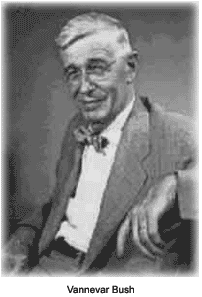 Also in 1945, Bush published an article in the Atlantic Monthly, called, "As We May Think." "Memex," a contraction of the words memory and extender, was described in the article as a theoretical machine that retrieved information from microfilm “which is mechanized so that it may be consulted with exceeding speed and flexibility." Life magazine published a condensed version of "As We May Think," in November of the same year and included several drawings illustrating the memex machine and its companion devices. It has also been shown as the precursor to the modern personal computer. This version of the essay inspired Ted Nelson and Douglas Engelbart to independently set down various ideas that later became the Internet’s "hypertext."
When Bush died on June 30, 1974, the Internet was in its infancy and the World Wide Web lay far in the future, but his ideas about connected information provided some of the inspiration for the revolution to come.
Also in 1945, Bush published an article in the Atlantic Monthly, called, "As We May Think." "Memex," a contraction of the words memory and extender, was described in the article as a theoretical machine that retrieved information from microfilm “which is mechanized so that it may be consulted with exceeding speed and flexibility." Life magazine published a condensed version of "As We May Think," in November of the same year and included several drawings illustrating the memex machine and its companion devices. It has also been shown as the precursor to the modern personal computer. This version of the essay inspired Ted Nelson and Douglas Engelbart to independently set down various ideas that later became the Internet’s "hypertext."
When Bush died on June 30, 1974, the Internet was in its infancy and the World Wide Web lay far in the future, but his ideas about connected information provided some of the inspiration for the revolution to come.