
American POWs (prisoners of war) of World War II endured everything from hunger and disease, to beatings and sudden death. During the war, a number of nations throughout the world ignored the provisions of the Geneva Convention and ginned up incarceration rules of their own. Soldiers were placed into many types of POW camps, but they all offered the same basic day-to-day life.
Japanese POW camps
POW camps in the Pacific were some of the worst in the war. In addition to military personnel, the Japanese incarcerated colonial civilians living in the area before the beginning of the war. The soldiers and others were given mats to sleep on and a diet of rice, vegetables, and (rarely) meat or fish. It was rare that fat appeared in their diet, and they were always hungry. Most of the men subsisted on barley, green stew and seaweed stew. They suffered from malnutrition, ulcers and cholera.
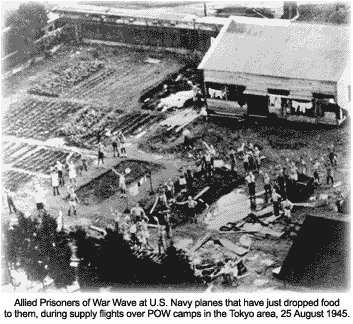 The Japanese camps were surrounded with Barbed Wire and high wooden fences. Armed guards in towers watched over the prisoners, and any man who tried to escape was shot. Some of the Japanese captors believed that it was expedient to demonstrate their superiority over the Americans by executing 10 men for one man`s attempt to escape.
The POWS in the Pacific theater were forced to learn Japanese, and when it was time for roll call, they had to recite their I.D. number in that language. If a prisoner did not know it, he would receive a beating. The prisoners also had to work many hard, long hours, laboring in places that ranged from mines, fields, and factories, to shipyards and railroads. One of the most notorious projects was the Burma-Thailand railway. Some 61,000 men were sent to work on it, and they were forced to build the 260-mile railroad all day long, 10 straight days, with only one day off. That railroad was built completely by hand and was by far the hardest job the Japanese put them through. Of all the men who worked on the railway, 13,000 died.
German POW camps
In Germany, the POW facilities varied from camps just for officers, to camps specifically for men in the navy. Each new soldier and civilian captured was processed through a Dulag (transit camp) where they were required to give their name, rank and serial number according to the Geneva Convention. The Germans took it one step further, however, and used tricky questioning to try to get information out of the Americans.
The Japanese camps were surrounded with Barbed Wire and high wooden fences. Armed guards in towers watched over the prisoners, and any man who tried to escape was shot. Some of the Japanese captors believed that it was expedient to demonstrate their superiority over the Americans by executing 10 men for one man`s attempt to escape.
The POWS in the Pacific theater were forced to learn Japanese, and when it was time for roll call, they had to recite their I.D. number in that language. If a prisoner did not know it, he would receive a beating. The prisoners also had to work many hard, long hours, laboring in places that ranged from mines, fields, and factories, to shipyards and railroads. One of the most notorious projects was the Burma-Thailand railway. Some 61,000 men were sent to work on it, and they were forced to build the 260-mile railroad all day long, 10 straight days, with only one day off. That railroad was built completely by hand and was by far the hardest job the Japanese put them through. Of all the men who worked on the railway, 13,000 died.
German POW camps
In Germany, the POW facilities varied from camps just for officers, to camps specifically for men in the navy. Each new soldier and civilian captured was processed through a Dulag (transit camp) where they were required to give their name, rank and serial number according to the Geneva Convention. The Germans took it one step further, however, and used tricky questioning to try to get information out of the Americans.
 After the men went through the Dulag, they were herded onto trains and shipped to the POW camps. The most well-known camps were Marlags, Oflags, and Stalags:
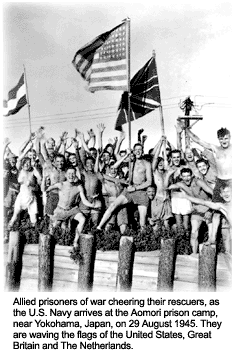 Many POWs attempted successful and not so successful attempts at escape. Even though nearly 50 percent of the POWs in the Pacific theater perished, only 17 percent of the soldiers in Germany died while in POW camps. The Germans did not fix as tight a grip on the prisoners as other countries, which induced the prisoners to think up of more ways to escape. Some of those attempts included sewing ersatz German uniforms or tunneling; men even dropped 100 feet out of windows. In one instance, POWs were building a glider under the roof of a chapel when their camp was liberated.
All of the escape attempts from the German POW camps came at a price of punishment and reprisal. Many escapees were shot under the Kugel Erlass (bullet decree) that the Germans strictly observed. An episode of the Kugel Erlass occurred when 50 pilots tried to escape from a camp in Silesia. When they were recaptured, they were quickly put to death by machine gun. Of all of the escapees from German POW camps, only 30 persons successfully reached Britain or a neutral country.
Many POWs attempted successful and not so successful attempts at escape. Even though nearly 50 percent of the POWs in the Pacific theater perished, only 17 percent of the soldiers in Germany died while in POW camps. The Germans did not fix as tight a grip on the prisoners as other countries, which induced the prisoners to think up of more ways to escape. Some of those attempts included sewing ersatz German uniforms or tunneling; men even dropped 100 feet out of windows. In one instance, POWs were building a glider under the roof of a chapel when their camp was liberated.
All of the escape attempts from the German POW camps came at a price of punishment and reprisal. Many escapees were shot under the Kugel Erlass (bullet decree) that the Germans strictly observed. An episode of the Kugel Erlass occurred when 50 pilots tried to escape from a camp in Silesia. When they were recaptured, they were quickly put to death by machine gun. Of all of the escapees from German POW camps, only 30 persons successfully reached Britain or a neutral country.