
One way the U.S. military advances during wartime is to develop whatever means it takes to protect American lives. World War II was no exception when the Quartermaster K-9 Corps, war dogs, were inducted into the armed forces. They are credited with great acts of heroism and saving thousands of American lives.
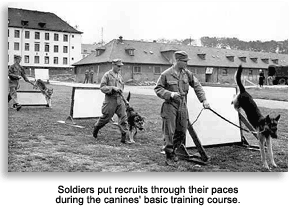 The Corp Begins
Shortly after the attack on Pearl Harbor, the American Kennel Association and an organization called Dogs for Defense, called for dog owners across the country to donate quality canines to the Army’s Quartermaster Corps. As the U.S. military went on the offensive in World War II, a new focus was to supply dogs for combat assistance through the K-9 Corps.
On March 13, 1942, Secretary of War Robert P. Patterson signed a letter that authorized the Quartermaster General to officially induct dogs into the war effort. They arrived by the thousands in all shapes and sizes. Initially there were 30 breeds accepted that were later narrowed down to just five: German Shepherds, Belgian Sheep Dogs, Doberman Pinschers, Farm Collies and Giant Schnauzers.
The first War Dog Reception and Training Center was established at Front Royal, Virginia, in August 1942. An initial estimate was that about 200 dogs would be needed, but that estimate changed quickly as requirements increased. Reception and training were transferred to the Quartermaster Remount Branch, while Dogs for Defense continued successfully to solicit donations of dogs from all of the 48 states. Numerous qualified civilian trainers came forward to volunteer their time and expertise, without pay. The program proved to be highly successful.
K-9 Training
In the fall of 1942, a K-9 Quartermaster Corps training center was established at Fort Robinson, Nebraska. Thousands of dogs were trained for war duty and were used to guard facilities, carry messages, sniff out mines, and pull sleds. The Quartermaster Corps trained the dog handlers, most of whom were quartermaster soldiers. A technical manual was designed in July 1943: TM 10-396, War Dogs, contained the doctrine for training and deployment.
Total training time was normally eight to 12 weeks. Basic training included such fundamental commands as "sit," "stay," "come," and others. The dogs also were introduced to muzzles, gas masks, gunfire and riding in vehicles. If the dogs passed the basic training routines, they were transferred to one of four specialized training programs where they underwent rigorous military training.
Canine Classes
The four classes consisted of sentry dogs, scout or patrol dogs, messenger dogs and mine dogs.
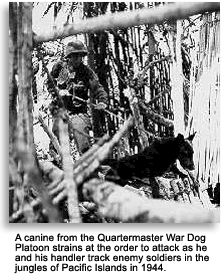 Only dogs with superior intelligence and a quiet disposition earned the title of scout dog. The quartermaster handler, along with his scout dog, walked on combat patrols well in front of the infantry patrol. The dogs could often detect the presence of an enemy at distances up to 1,000 yards ahead, thereby greatly reducing the danger of ambush. Alerted to the enemy, they stiffened their body, raised their hackles, pricked up their ears and held their tails rigid. The use of those dogs boosted servicemen’s morale.
Notable War Dogs
A number of dogs trained by the Quartermaster Corps earned outstanding records in combat overseas. Probably the most famous war dog was named Chips. Donated and trained at Front Royal, Virginia, Chips was among the first dogs shipped overseas. Assigned to the Third Infantry Division in North Africa, one of his assignments included sentry duty at the Roosevelt-Churchill Conference in Casablanca, Morocco, in January 1943.
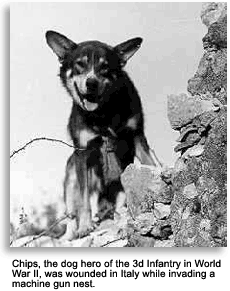 On another occasion, Chips, sensing danger, broke away from his handler to attack a pillbox containing an enemy machine gun nest. A bullet pierced his body, but, ignoring the pain, he threw himself upon the enemy and forced the entire crew to surrender. Chips was awarded the Distinguished Service Cross, Silver Star and Purple Heart. Unfortunately, all medals were revoked due to an Army policy preventing official commendation of animals. Even though Chips did not need an award to validate his heroism, his service friends took the matter into their own hands and bestowed a theater ribbon on their pal.
Chips finished his tour of duty in 1945 and returned to his U.S. family. The 1990 Disney TV movie, Chips, the War Dog, chronicles his life and war-time accomplishments.
In 2018 and 2019, nearly 75 years later, Chips received a posthumous Dickin Medal and Animals in War & Peace Medal of Bravery, prestigious international and national awards for valor in animal warriors.
Legacy & Honor
By 1945 the Quartermaster Corps had trained 10,425 dogs, including 9,295 for sentry duty, issued to the Army, Navy (Marines) and the Coast Guard. Fewer than 1,900 of those animals were shipped abroad, and by the end of the war only 436 had actually served overseas.
They rendered the services to which they were assigned by utilizing powers that humans do not possess. Proving to be an unqualified success during combat, the war dogs — deemed a "special weapon" — were instrumental in saving numerous lives in the line of fire.
In 1994, a war dog cemetery was dedicated at the U.S. Marine Corps War Dog Cemetery on the Island of Guam, to honor dogs that served in the Pacific Theater during World War II. Since then, U.S. War Dog Memorials have been established across the country, including in Pennsylvania, California, Colorado, Tennessee, Michigan, Texas, and New Jersey.
SOURCES & FURTHER READING
War Dogs: Four Legged Fighters. Department of Defense. www.defense.gov/Multimedia/Experience/Four-Legged-Fighters