
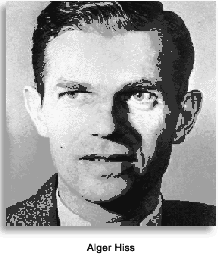
Alger Hiss was a controversial figure in American politics following World War II. His trials for perjury in 1949 and 1950 divided the country. To those on the Left, the Hiss case was an example of persecution by irresponsible anti-Communists. That Richard Nixon's career benefited by the case made it even worse. For those on the Right, Hiss represented the sort of soft-headed Eastern intellectuals who could not be trusted in matters of national security.
Alger Hiss was born in Baltimore, Maryland, on November 11, 1904. He received a bachelor's degree from Johns Hopkins University and a law degree from Harvard in 1929. He then entered government service. Hiss clerked for Oliver Wendell Holmes, a justice of the U.S. Supreme Court, before serving in the Roosevelt Administration in the departments of Agriculture, Justice and State.
 Hiss also played a role on the international stage as Roosevelt's adviser at the Yalta Conference in 1945, and later, briefly as secretary general of the United Nations. In 1949 Hiss became president of the Carnegie Endowment for International Peace.
In August 1948 one Whittaker Chambers appeared before the House Committee on Un-American Activities and testified that Hiss had been spying for the Soviet Union. In a federal grand jury investigation of the case, Hiss denied Chambers' accusations. However, Chambers had produced damaging, if circumstantial, evidence and Hiss was charged with perjury. His first trial in 1949 ended in a hung jury, but the following year, a second jury found Hiss guilty and sentenced him to five years' imprisonment.
After his release from prison in 1954, Hiss tried repeatedly to clear his name. In the 1970s he unsuccessfully sued the U.S. government, under the Freedom of Information Act, to gain access to FBI and State Department files about the case.
The National Security Agency did release transcripts of certain World War II telegraph cables between Soviet agents in the United States and Moscow. One such message from March 1945 refers to an American, code named Ales, who was a Soviet agent working in the State Department. It said that Ales accompanied President Franklin D. Roosevelt to the 1945 Yalta Conference and then flew to Moscow. Because Hiss was with Roosevelt at Yalta, it has been claimed that he was the Ales referred to in the cable.
In 1988, Oleg Gordievsky, a high-ranking KGB defector, identifed Hiss as Ales. With the collapse of the Soviet Union, attempts were made to obtain information on the case from the Soviet intelligence files. No confirmation from Soviet files ever showed that Hiss had ever been an agent for any intelligence agency of the Soviet Union.
Alger Hiss died on 15th November, 1996. Even after his death, scholars continued to debate the issue and no definite resolution now seems likely.
Hiss also played a role on the international stage as Roosevelt's adviser at the Yalta Conference in 1945, and later, briefly as secretary general of the United Nations. In 1949 Hiss became president of the Carnegie Endowment for International Peace.
In August 1948 one Whittaker Chambers appeared before the House Committee on Un-American Activities and testified that Hiss had been spying for the Soviet Union. In a federal grand jury investigation of the case, Hiss denied Chambers' accusations. However, Chambers had produced damaging, if circumstantial, evidence and Hiss was charged with perjury. His first trial in 1949 ended in a hung jury, but the following year, a second jury found Hiss guilty and sentenced him to five years' imprisonment.
After his release from prison in 1954, Hiss tried repeatedly to clear his name. In the 1970s he unsuccessfully sued the U.S. government, under the Freedom of Information Act, to gain access to FBI and State Department files about the case.
The National Security Agency did release transcripts of certain World War II telegraph cables between Soviet agents in the United States and Moscow. One such message from March 1945 refers to an American, code named Ales, who was a Soviet agent working in the State Department. It said that Ales accompanied President Franklin D. Roosevelt to the 1945 Yalta Conference and then flew to Moscow. Because Hiss was with Roosevelt at Yalta, it has been claimed that he was the Ales referred to in the cable.
In 1988, Oleg Gordievsky, a high-ranking KGB defector, identifed Hiss as Ales. With the collapse of the Soviet Union, attempts were made to obtain information on the case from the Soviet intelligence files. No confirmation from Soviet files ever showed that Hiss had ever been an agent for any intelligence agency of the Soviet Union.
Alger Hiss died on 15th November, 1996. Even after his death, scholars continued to debate the issue and no definite resolution now seems likely.