
World War I severely disrupted agriculture in Europe. That was an advantage to farmers in the United States, who increased production dramatically and were therefore able to export surplus food to European countries. But by the 1920s, European agriculture had recovered and American farmers found it more difficult to find export markets for their products. Farmers continued to produce more food than could be consumed, and prices began to fall.
The decline in demand for agricultural products meant that many farmers had difficulty paying the mortgages on their farms. By the 1930s, many American farmers were in serious financial difficulty.
In South Dakota, the county grain elevators listed corn as minus three cents a bushel — if a farmer wanted to sell them a bushel of corn, he had to bring in three cents. Fields of cotton lay unpicked, because it couldn`t be sold even for the price of picking. Orchards of olive trees hung full of rotting fruit. Oranges were being sold at less than the cost of production. Grain was being burned instead of coal because it was cheaper.
When Franklin D. Roosevelt was inaugurated president in 1933, he called Congress into special session to introduce a record number of legislative proposals under what he dubbed the New Deal. One of the first to be introduced and enacted was the Agricultural Adjustment Act. The intent of the AAA was to restore the purchasing power of American farmers to pre-World War I levels. The money to pay the farmers for cutting back production by about 30 percent was raised by a tax on companies that bought farm products and processed them into food and clothing.
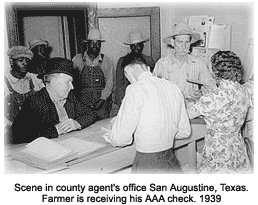 The AAA evened the balance of supply and demand for farm commodities so that prices would support a decent purchasing power for farmers. This concept was known as "parity."
AAA controlled the supply of seven "basic crops" — corn, wheat, cotton, rice, peanuts, tobacco, and milk — by offering payments to farmers in return for farmers not planting those crops.
The AAA also became involved in assisting farmers ruined by the advent of the Dust Bowl in 1934.
In 1936 the Supreme Court, ruling in United States v. Butler, declared the AAA unconstitutional. Writing for the majority, Justice Owen Roberts stated that by regulating agriculture, the federal government was invading areas of jurisdiction reserved by the constitution to the states, and thus violated the Tenth Amendment. Judge Harlan Stone responded for the minority that, "Courts are not the only agency of government that must be assumed to have capacity to govern."
Further legislation by Congress restored some of the act`s provisions, encouraging conservation, maintaining balanced prices, and establishing food reserves for periods of shortages.
Congress also adopted the Soil Conservation and Domestic Allotment Act, which encouraged conservation by paying benefits for planting soil-building crops instead of staple crops. The rewritten statutes were declared constitutional by the Supreme Court in Mulford v. Smith (1939) and Wickard v. Filburn (1942).
During World War II, the AAA turned its attention to increasing food production to meet war needs. The AAA did not end the Great Depression and drought, but the legislation remained the basis for all farm programs in the following 70 years.
The AAA evened the balance of supply and demand for farm commodities so that prices would support a decent purchasing power for farmers. This concept was known as "parity."
AAA controlled the supply of seven "basic crops" — corn, wheat, cotton, rice, peanuts, tobacco, and milk — by offering payments to farmers in return for farmers not planting those crops.
The AAA also became involved in assisting farmers ruined by the advent of the Dust Bowl in 1934.
In 1936 the Supreme Court, ruling in United States v. Butler, declared the AAA unconstitutional. Writing for the majority, Justice Owen Roberts stated that by regulating agriculture, the federal government was invading areas of jurisdiction reserved by the constitution to the states, and thus violated the Tenth Amendment. Judge Harlan Stone responded for the minority that, "Courts are not the only agency of government that must be assumed to have capacity to govern."
Further legislation by Congress restored some of the act`s provisions, encouraging conservation, maintaining balanced prices, and establishing food reserves for periods of shortages.
Congress also adopted the Soil Conservation and Domestic Allotment Act, which encouraged conservation by paying benefits for planting soil-building crops instead of staple crops. The rewritten statutes were declared constitutional by the Supreme Court in Mulford v. Smith (1939) and Wickard v. Filburn (1942).
During World War II, the AAA turned its attention to increasing food production to meet war needs. The AAA did not end the Great Depression and drought, but the legislation remained the basis for all farm programs in the following 70 years.