
Early in World War II the United States devised a plan, dubbed Lend-Lease, to assist the nations that were then fighting the Axis powers (Germany, Japan and Italy). Roosevelt began talking about the plan at a news conference on December 17, 1940, and expanded on the idea during a Fireside Chat on December 29. During the news conference, he commented:
It is possible--I will put it that way--for the United States to take over British orders and, because they are essentially the same kind of munitions that we use ourselves, turn them into American orders. We have enough money to do it. And thereupon, as to such portion of them as the military events of the future determine to be right and proper for us to allow to go to the other side, either lease or sell the materials, subject to mortgage, to the people on the other side. That would be on the general theory that it may still prove true that the best defense of Great Britain is the best defense of the United States, and therefore that these materials would be more useful to the defense of the United States if they were used in Great Britain than if they were kept in storage here.The proposal brought fierce opposition from isolationists, who correctly regarded it as tantamount to a declaration of war on Germany. Senator Burton Wheeler of Montana drove home the point that there was no statutory limit on the proportion of American defense which Roosevelt could in theory lend to the British:
It gives to one man - responsible to no one - the power to denude our shores of every warship. It gives to one individual the dictatorial power to strip the American Army of our every tank, cannon, rifle, or antiaircraft gun. No one would deny that the lend-lease-give bill contains provisions that would enable one man to render the United States defenseless, but they will tell you, "The President would never do it." To this I say, "Why does he ask the power if he does not intend to use it?" Why not, I say, place some check on American donations to a foreign nation?Advocates of Lend-Lease took pains to portray aid to Britain as a means to prevent war with Germany eventually spilling into the Western Hemisphere. Henry Knox, publisher of the Chicago Daily News and Alf Landon`s vice-presidential running mate in 1936, testified before Congress that:
We can be very sure that the devious diplomatic, economic, and political methods which Germany has employed toward all the countries near her would also in the future be employed in the regions to the south of us. First would come economic penetration, near economic dependence, then political immigration and political interference. After that we would see the establishment of puppet regimes under Nazi or native control, and finally the arming of those countries and their military domination by Nazis ...The Lend-Lease Act was passed by Congress on March 11, 1941. It provided that the president could ship weapons, food, or equipment to any country whose struggle against the Axis assisted U.S. defense. By retooling U.S. industrial output to the demands of war, Lend-Lease formally eliminated any semblance of neutrality. President Franklin D. Roosevelt summarized the Lend-Lease Act as "helping to put out the fire in your neighbor`s house before your own house caught fire and burned down." In effect, it turned the U.S. into an "arsenal of democracy" following the eruption of hostilities. At the outset, $7 billion worth of American matérial was shipped to Great Britain, China, Russia, Brazil and eventually many other countries. The expenditure grew to $50 billion by 1945. Each of those nations was assumed to be fighting not only in its own defense, but in that of the United States as well.* By permitting the president to ship war equipment and supplies to a besieged Britain, without payback as stipulated by the 1939 Neutrality Act, Lend-Lease empowered the British to resist the German onslaught until Pearl Harbor spurred America into the conflict. In addition, it avoided the prickly issues of post-World War I war debts.I believe that our people now are determined to put forth their full efforts for saving Britain and thus saving themselves from the burdens of future militarism and war and from an overturn of American life.
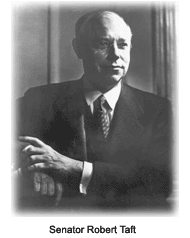 Lend-lease advanced the United States to the edge of war. Such Isolationists as Republican senator Robert Taft spoke against it. The bill would "...give the president power to carry on a kind of undeclared war all over the world, in which America would do everything except actually put soldiers in the frontline trenches where the fighting is," he correctly observed.
Following World War II, no decision was arrived at for the return of Lend-Lease goods by recipient nations. Some countries, notably Great Britain, had previously offset part of their indebtedness by providing U.S. GIs with goods and services.
Many believed that calling for the return of lent goods would hurt stateside manufacturers economically. Some authorities maintained that all nations fighting the Axis powers had given their all to vanquishing the enemy. They argued that American Lend-Lease contributions were offset by the other Allies` sacrifices.
Lend-lease advanced the United States to the edge of war. Such Isolationists as Republican senator Robert Taft spoke against it. The bill would "...give the president power to carry on a kind of undeclared war all over the world, in which America would do everything except actually put soldiers in the frontline trenches where the fighting is," he correctly observed.
Following World War II, no decision was arrived at for the return of Lend-Lease goods by recipient nations. Some countries, notably Great Britain, had previously offset part of their indebtedness by providing U.S. GIs with goods and services.
Many believed that calling for the return of lent goods would hurt stateside manufacturers economically. Some authorities maintained that all nations fighting the Axis powers had given their all to vanquishing the enemy. They argued that American Lend-Lease contributions were offset by the other Allies` sacrifices.