
In recognition of Southern support for California's admission to the Union as a free state and ending the slave trade in the District of Columbia, as part of the Compromise of 1850, Congress enacted the Fugitive Slave Act to assist the South with maintaining a tight rein on slaveholders’ property.
Existing laws had created a system designed to enforce the institution of slavery. Southern states usually had slave codes that prevented slaves from being "at large" without a pass. Any black determined to be more than a certain number of miles from his home was automatically considered a fugitive and could be thrown in jail. In Northern states like Massachusetts, however, opinion was sufficiently hostile that slaveowners could not rely on local courts to uphold their property rights.
The new law created a force of federal commissioners empowered to pursue fugitive slaves in any state and return them to their owners. No statute of limitations applied, so that even those slaves who had been free for many years could be (and were) returned.
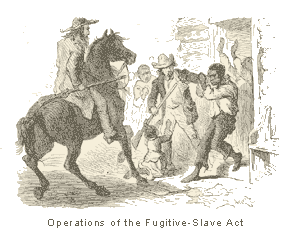 The commissioners enjoyed broad powers, including the right to compel citizens to assist in the pursuit and apprehension of runaways; fines and imprisonment awaited those who refused to cooperate. United States marshals were required to be diligent in the enforcement of the act and could be fined for being lax. A captured runaway could not testify on his own behalf and was not entitled to a court trial. The commissioners received a fee of 10 dollars for every slave returned; the fee was reduced to five dollars if the accused slave were released.
The passage and enforcement of this law enraged many in the North. Some states reacted by passing legislation designed to hamper the federal commissioners' activities, but such laws were declared unconstitutional by the U.S. Supreme Court. Riots occurred in some Northern communities and soldiers were deployed to restore order.
The 1852 publication of Uncle Tom’s Cabin capitalized upon the Northern sensibilities, which had been rubbed raw by the Fugitive Slave Act. Massachusetts went so far as to pass the Massachusetts Personal Liberty Act of May 21, 1855, in order to frustrate the Fugitive Slave Act within its borders. The primary provocation had been the "trial" of Anthony Burns, who been arrested, tried, and returned to his purported master after living as a free black in Boston.