
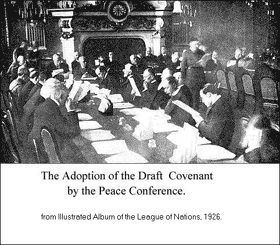
The initial draft of the Covenant of the League of Nations was completed hurriedly in early 1919, under the close supervision of President Woodrow Wilson. The proposed new international organization was to be composed of three bodies:
Woodrow Wilson campaigned hard for ratification of the covenant. He was especially proud of Article 10, as can be seen in this excerpt from a speech in Pueblo, Colorado, in September, 1919:
When you come to the heart of the Covenant, my fellow citizens, you will find it in article ten, and I am very much interested to know that the other things have been blown away like bubbles. There is nothing in the other contentions with regard to the league of nations, but there is something in article ten that you ought to realize and ought to accept or reject. Article ten is the heart of the whole matter. What is article ten? I never am certain that I can from memory give a literal repetition of its language, but I am sure that I can give an exact interpretation of its meaning. Article ten provides that every member of the league covenants to respect and preserve the territorial integrity and existing political independence of every other member of the league as against external aggression. Not against internal disturbance. There was not a man at that table who did not admit the sacredness of the right of self-determination, the sacredness of the right of any body of people to say that they would not continue to live under the Government they were then living under, and under article eleven of the Covenant they are given a place to say whether they will live under it or not. For following article ten is article eleven, which makes it the right of any member of the League at any time to call attention to anything, anywhere, that is likely to disturb the peace of the world or the good understanding between nations upon which the peace of the world depends.Under the terms of the U.S. Constitution, an international treaty such as the Treaty of Versailles could not take effect unless confirmed by the Senate. Debate over the treaty raged through 1919. Three camps emerged. A bloc of senators known as the Irreconcilables opposed the treaty in any form. On the other side were senators who agreed with Wilson that the treaty should be confirmed as written. In the middle were those like Henry Cabot Lodge who wanted the treaty ratified with reservations. Lodge`s proposed reservations would have given the United States the right to withdraw at any time on its own terms and to decline participation in any military action initiated by the League. It also asserted the Monroe Doctrine as being above any provisions of the Covenant. Wilson opposed any reservations.
No formula could be devised that would satisfy the required two-thirds of the Senate, which failed on March 19, 1920, to confirm the treaty and finally returned it to the White House unconfirmed.