French Aspirations and Compromise
Woodrow Wilson arrived back in Europe on March 14, 1919, following a contentious work session at home. Lines of division had been drawn sharply between the president and the Republican-controlled Senate over the nature of the pending peace agreement.
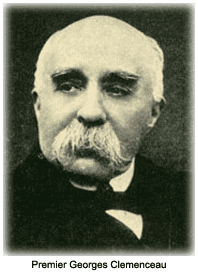 Relationships in Paris were, if anything, worse. The crafty and cynical Premier Georges Clemenceau, known to his countrymen as “the Tiger,” was an effective advocate of French interests and held little sympathy for Wilson’s idealistic approach to peace. He remarked, “God gave us the Ten Commandments and we broke them. Wilson gives us the Fourteen Points. We shall see.” Having suffered two devastating invasions from Germany in the past 50 years, the French in 1919, were intent on humbling Germany, not for the immediate future, but for generations. Two issues dominated French thinking:
- Reparations. Clemenceau insisted on receiving compensation for damages incurred during the war, but sought to defer the determination of the actual amount to be collected from the aggressor. Instead, Germany would in effect be asked to sign a “blank check” for reparations in an amount to be set at a later time.
- Buffer Zones. In addition to monetary awards, the French sought the creation of buffer territories to insulate them against future German aggression. The French asked for the right to occupy all territory up to the west bank of the Rhine River or, failing that, for the creation of a new buffer state. These demands were resisted by Wilson as running counter to his ideal of territorial self-determination; he did not want Germans living under French control — an obvious source of irritation and a likely contributor to future conflict.
The French press and public, which had recently held Wilson in almost reverential terms, turned sharply against the president for resisting their national aspirations. Suffering from fatigue and the flu, Wilson clashed bitterly with Clemenceau and at one point in early April threatened to return to the United States. Perhaps in part due to that threat, a compromise was reached on two territorial issues of vital importance to France:
- The Rhineland. The area bordering the great river was to be occupied by the French for a maximum of 15 years.
- The Saar Basin. This area, rich in coal, also was to be occupied by the French for up to 15 years, then a plebiscite would be held to determine its ultimate allegiance.
As a further inducement to accept compromise, the French were offered a defensive treaty with the United States and Britain, pledging military assistance in the event of an unprovoked attack by Germany — a measure certain to raise the ire of the increasingly
isolationist U.S. Senate.
See also
Wilson's Search for Peace.
