
The repeal of the Townshend duties in the Spring of 1770 did much to soothe strained relations between the American colonies and the mother country. For the next three years a surface harmony prevailed, but several incidents occurred that served to indicate not all was well. One such event occurred in Rhode Island where local forces resorted to violence and property destruction to oppose the enforcement of unpopular British trade policies.
The British revenue cutter Gaspee had served in American waters since 1764 and early on had drawn resentment by impressing a number of American colonists. This uneasy situation became worse in 1772 when the ship was under the command of Lieutenant William Dudingston and was assigned to the New England coast in a crackdown on smuggling. Narragansett Bay was then the center of a thriving illegal trade. Dudingston was so intent on his duties that he needlessly offended an already nervous public by seizing colonial supplies without payment and by stopping many innocent ships. Further harm was done by Dudingston’s tendency to express publicly his contempt for Americans.
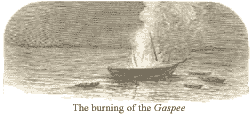 On June 9, Dudingston pursued a suspect local vessel, the Hannah, under the command of Captain Benjamin Lindsey. The fleeing ship purposely lured the Gaspee into shallow waters off Namquit Point, near present-day Warwick, where it ran aground. John Brown, Joseph Bucklin and other Providence leaders received word of the Gaspee’s plight and organized a raiding party. That night, under a moonless sky, more than 60 men with blackened faces and feathered headdresses boarded longboats and silently approached the stranded vessel. At about 1 a.m. on the 10th, the raiders were spotted by some of the Gaspee’s crew and warned to halt. The Americans ignored the order and opened fire, seriously wounding Dudingston in the arm. Most of the crew had been asleep and were easily rounded up and removed from the ship. The hated Dudingston was initially left to writhe in agony on the deck, but was later taken to a doctor. When all crewmen were removed, the Gaspee was set aflame and over the next few hours burned to the waterline. This destruction of government property was a direct challenge to royal authority.
Rhode Island Governor Joseph Wanton, a popularly elected official, felt compelled to issue an arrest proclamation for the unnamed participants in the event and went through the motion of posting a reward. He later submitted an inconclusive report on the incident to London.
British officials, realizing that the colony’s commitment to achieving justice was limited, created a Royal Commission of Inquiry comprising Governor Wanton and four judges from other colonies. The commission met in early 1773, had difficulty getting witnesses to testify and, when they succeeded, found their accounts were often contradictory. In the end the commission showed remarkable restraint and issued a report finding that the Gaspee incident was a spontaneous event prompted by Dudingston's numerous provocations. Despite the fact that the raiders' names were well known in the community, they were never divulged to British officials.
This act of destruction was the beginning of the end of the quiet period that had existed for more than two years. Radical forces in Rhode Island chose to ignore the fact that the royal commission had striven to avoid controversy, and stressed the negative in a series of newspaper attacks. The greatest immediate fear was that the colony would be punished by seeing its charter revoked and a royal governor installed. A few months later, the focus of activity would switch to Boston where the tea party would force the authorities in London to take actions that had earlier been feared in Rhode Island.
On June 9, Dudingston pursued a suspect local vessel, the Hannah, under the command of Captain Benjamin Lindsey. The fleeing ship purposely lured the Gaspee into shallow waters off Namquit Point, near present-day Warwick, where it ran aground. John Brown, Joseph Bucklin and other Providence leaders received word of the Gaspee’s plight and organized a raiding party. That night, under a moonless sky, more than 60 men with blackened faces and feathered headdresses boarded longboats and silently approached the stranded vessel. At about 1 a.m. on the 10th, the raiders were spotted by some of the Gaspee’s crew and warned to halt. The Americans ignored the order and opened fire, seriously wounding Dudingston in the arm. Most of the crew had been asleep and were easily rounded up and removed from the ship. The hated Dudingston was initially left to writhe in agony on the deck, but was later taken to a doctor. When all crewmen were removed, the Gaspee was set aflame and over the next few hours burned to the waterline. This destruction of government property was a direct challenge to royal authority.
Rhode Island Governor Joseph Wanton, a popularly elected official, felt compelled to issue an arrest proclamation for the unnamed participants in the event and went through the motion of posting a reward. He later submitted an inconclusive report on the incident to London.
British officials, realizing that the colony’s commitment to achieving justice was limited, created a Royal Commission of Inquiry comprising Governor Wanton and four judges from other colonies. The commission met in early 1773, had difficulty getting witnesses to testify and, when they succeeded, found their accounts were often contradictory. In the end the commission showed remarkable restraint and issued a report finding that the Gaspee incident was a spontaneous event prompted by Dudingston's numerous provocations. Despite the fact that the raiders' names were well known in the community, they were never divulged to British officials.
This act of destruction was the beginning of the end of the quiet period that had existed for more than two years. Radical forces in Rhode Island chose to ignore the fact that the royal commission had striven to avoid controversy, and stressed the negative in a series of newspaper attacks. The greatest immediate fear was that the colony would be punished by seeing its charter revoked and a royal governor installed. A few months later, the focus of activity would switch to Boston where the tea party would force the authorities in London to take actions that had earlier been feared in Rhode Island.