
The Chautauqua Movement sought to bring learning, culture and, later, entertainment to the small towns and villages of America during the late 19th and early 20th centuries.
Pre-Civil War roots of the effort existed in the lyceum movement, which paid prominent personalities handsomely to give speeches on religious, political and scientific topics to gatherings in the hinterlands. This was an approach to adult education that underscored the values of an era in which common people were expected to stay close to job and family. Enlightenment, if any, had to be taken to them. Travel and vacations were the preserves of the wealthy.
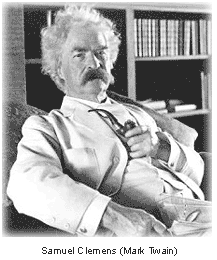 Social changes occurring in post-war America included the emerging democratization of education. On the shores of Lake Chautauqua in western New York, an assembly was held between August 4 and 18, 1874. The organizers were John H. Vincent, secretary of the Methodist Sunday School and later bishop of the Methodist Episcopal Church, and Lewis Miller, an Akron, Ohio businessman. The original intent was provide an pleasant setting in which to train Sunday school teachers in all Protestant denominations. Eight-week sessions were staged each summer and were later opened to the general public. Within a few years, the idea had been extended to include lectures, discussions, home readings, which recalled the Lyceum movement. Headliners such as Mark Twain and William Jennings Bryan attracted huge throngs, and all of the presidents from Grant through McKinley made appearances.
Originally called the Chautauqua Sunday School Assembly, the range of subjects grew apace. Additions included Hebrew and Greek in 1875, English literature in 1876, French and German in 1878. In 1878, William Rainey Harper, a prominent educator of the day, developed a home study program known as the Literary and Scientific Circle for those who could not attend the summer sessions. Around 7000 people took part in the first year.
Local reading groups formed in communities throughout the nation to discuss the leading issues of the day. Later, a formal correspondence school was established, which provided certification for those who completed the rigorous studies and passed examinations. At its zenith, the Chautauqua officials also operated a large publishing house and a theological school.
As the years passed, more emphasis was placed on singing groups, oompah bands, theatrical presentations and magic lantern shows. The advent of the railroads and their cheap fares had made it possible for working-class families to attend the sessions. The Chautauqua gatherings became a blend of a county fair and revival meeting.
By the turn of the century, many communities had formed their own “chautauquas,” unrelated to the New York institution, that paid lecturers and performers to participate in their local events.
Following World War I, the availability of automobiles, radio programming and motion pictures eroded the Chautauqua Movement`s appeal. Annual attendance had remained around 45,000 at the general assembly each year between 1924 and 1932, after which attendance fell of sharply due to The Great Depression. Television was a further challenge. Independent local activities died out, but the national organization has continued on a reduced scale to the present day.
Social changes occurring in post-war America included the emerging democratization of education. On the shores of Lake Chautauqua in western New York, an assembly was held between August 4 and 18, 1874. The organizers were John H. Vincent, secretary of the Methodist Sunday School and later bishop of the Methodist Episcopal Church, and Lewis Miller, an Akron, Ohio businessman. The original intent was provide an pleasant setting in which to train Sunday school teachers in all Protestant denominations. Eight-week sessions were staged each summer and were later opened to the general public. Within a few years, the idea had been extended to include lectures, discussions, home readings, which recalled the Lyceum movement. Headliners such as Mark Twain and William Jennings Bryan attracted huge throngs, and all of the presidents from Grant through McKinley made appearances.
Originally called the Chautauqua Sunday School Assembly, the range of subjects grew apace. Additions included Hebrew and Greek in 1875, English literature in 1876, French and German in 1878. In 1878, William Rainey Harper, a prominent educator of the day, developed a home study program known as the Literary and Scientific Circle for those who could not attend the summer sessions. Around 7000 people took part in the first year.
Local reading groups formed in communities throughout the nation to discuss the leading issues of the day. Later, a formal correspondence school was established, which provided certification for those who completed the rigorous studies and passed examinations. At its zenith, the Chautauqua officials also operated a large publishing house and a theological school.
As the years passed, more emphasis was placed on singing groups, oompah bands, theatrical presentations and magic lantern shows. The advent of the railroads and their cheap fares had made it possible for working-class families to attend the sessions. The Chautauqua gatherings became a blend of a county fair and revival meeting.
By the turn of the century, many communities had formed their own “chautauquas,” unrelated to the New York institution, that paid lecturers and performers to participate in their local events.
Following World War I, the availability of automobiles, radio programming and motion pictures eroded the Chautauqua Movement`s appeal. Annual attendance had remained around 45,000 at the general assembly each year between 1924 and 1932, after which attendance fell of sharply due to The Great Depression. Television was a further challenge. Independent local activities died out, but the national organization has continued on a reduced scale to the present day.