
Francis Drake was one of the most famous men of his age, having won royal favor, and amassed a fortune from preying on Spanish ships and ports. Born in Devonshire, England, he was the son of a tenant farmer and lay preacher who instilled in his family an abiding hatred of Roman Catholicism and Spain. Young Drake was apprenticed to a seaman and learned his craft well while sailing the dangerous waters of the North Sea.
 Drake received his first command in 1567 and sailed with John Hawkins on a slave-trading venture in the Caribbean. The small fleet was attacked by Spanish ships; many English lives were lost and Drake's hatred of Spain deepened. In 1570 and 1571, he headed successful trading voyages to the West Indies, but he altered his path in 1572, when he turned his attention to privateering.
Marauding forays in the Caribbean were set aside by the crown for a few years in the mid-1570s. Drake was sent to Ireland, where he led sea forces against Irish rebels.
In 1577, Drake commenced his most famous voyage. His small fleet was quickly depleted after easy passage through the deadly Magellan Strait (discovered by Magellan in 1520), when it took the brunt of major storms as it sailed into the Pacific Ocean. He went south to what is presumably the Pactolus Bank, and then went back north to reach islands west of Cape Horn. This was in 1578.
Of the five original vessels, only Drake’s Golden Hind remained. The Spanish defenses, however, were totally unprepared for the enemy. Drake managed to attack Spanish ports and shipping almost at will. He continued to sail northward in his drive to discover the elusive Northwest Passage, and probably progressed as far as the present-day U.S.-Canadian border.
Discouraged by foul weather, Drake retreated south to San Francisco Bay (which he named New Albion) for supplies and repairs. Drake knew that a hostile Spanish fleet awaited him if he tried to enter the Atlantic, so he pushed westward across the Pacific, his ship lowered to the waterline by the weight of Spanish plunder.
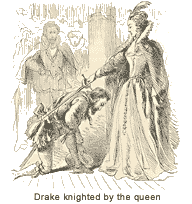
He traded successfully for spices and silks in the East Indies and in 1580, rounded the tip of Africa into the Atlantic. Elizabeth greeted Drake aboard the Golden Hind and knighted him — a clear affront to Philip II and Spain.
In 1581, Drake became mayor of Plymouth and later served in Parliament. In 1585, he returned to sea, conducted a series of raids against Spanish positions in the West Indies, then attacked and burned the Spanish fort town of St. Augustine in Florida.
On his return voyage, he anchored at Roanoke Island and plucked up the dispirited colonists sent there by Walter Raleigh. Drake may have imported the first tobacco into England during this voyage.
England was well aware that Spain was preparing a fleet to spearhead an invasion. In 1587, Drake was dispatched to Cádiz, where his fleet destroyed 30 Spanish ships in a preemptive attack. Drake proudly proclaimed that he and his men had singed the beard of Philip II, then promised that they would do more later.
A rebuilt Spanish Armada launched an invasion of England in 1588. Drake served as vice admiral under Lord Howard and emerged from the famous victory as the greatest English national hero.
In 1595, Drake accompanied Hawkins on a raiding venture to the West Indies, where he contracted a fever, died, and was buried at sea.